Thursday, November 8, 2012


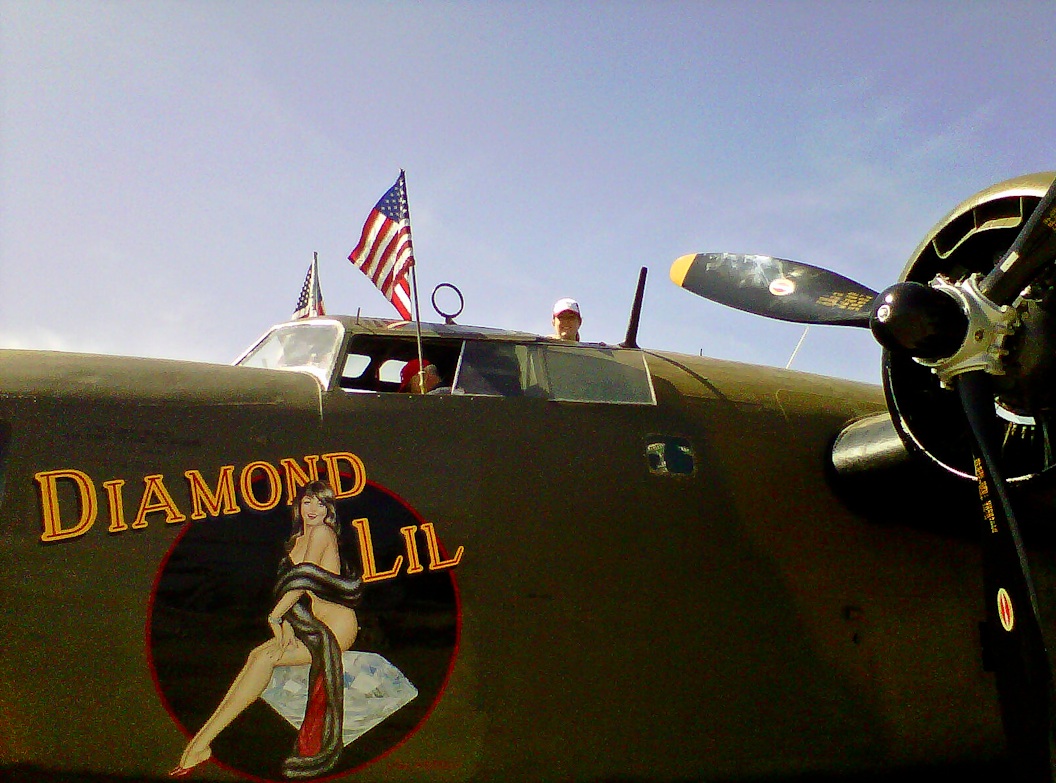
To round out my research into my grandfather's participation in WWII and the 456thBG, I was determined to get a real life experience flying in a Consolidated B-24 Liberator.  I saw one on the ground at the air show earlier this year, but that model of the B-24 was actually a pre-war model that was maybe used in the earliest part of the war, but was quickly replaced by more practical models.
At the airshow
The Collings Foundation Wings of Freedom Tour travels around the country year-round with several WWII aircraft, one of which is a B-24J model.  When it was initially restored in 1989, the airplane was painted to celebrate the 15th Air Force out of Italy, using the colors and nose art of the "All-American," whose crew achieved a record by shooting down 14 enemy aircraft in a single mission and was only one of two planes to return that day out of a squadron of 19.  Over the years, the B-24J has had two additional facelifts, one to honor the War in the Pacific taking on the colors and art of the "Dragon & His Tail," and it's present-day representation of "Witchcraft," a member of the 8th Air Force, 467th bombardment group, 790th bomb squadron that served in England and the EuropeanTheater of Operations (ETO) and completed a record 130 combat missions.  Taking a short trip on the restored Liberator isn't cheap, but much of the money goes to counter the high cost of maintaining these planes that are 70 years old.
When I arrived at the airport, the B-17 on tour with the B-24 was getting ready to take off with its group of warbird enthusiasts.  Once it had cleared the loading area, my small group (maximum 10 people) was ushered to the B-24.  When they describe this as an authentic experience, they aren't joking.  There are no added safety features to this plane - large openings (windows) for the guns with no plexiglass and we boarded the Liberator just like the crews did in WWII, through the bomb bay doors on the belly of the plane (see the slatted doors that are open under the wing).  We hoisted ourselves up onto the narrow (maybe 10" wide) catwalk that traverses the bomb compartment.  I remember reading in Mr. Shuster's memoir that the bomb bay doors were not thick and definitely not capable of holding the weight of a human, which made the in-flight crossing rather perilous.  I was surprised that they only had some ropes strung from one bulkhead to the next to assist you.
Narrow Catwalk
Once inside, we then headed to the tail where we were assigned places to sit.  I had the seat next to the waist gunner position, facing the tail on the floor of the plane, buckled to a bulkhead.  Once we were airborne, it was surprisingly quick before we heard the bell that gave us the all clear to walk around.  
My seat was behind the star
Buckled in for take off
We had about 20-25 minutes to wander the entire B-24 from nose to tail.  I started heading back to the tail gunner position, just out of convenience, then enjoyed the views of York and Gettysburg from the open windows before heading around the ball gunner to the narrow catwalk.  Yes, that is a gap around the ball turret in the photo below!  I actually dropped my lens cap as I was waiting for my turn on the catwalk, and it almost did a 10,000 foot plunge towards the farmland below.  Fortunately, I caught it just in time.
Tail Gunner
Ball Turret
In the nose of the plane, you had two places to explore.  Hoist yourself up, and you're in the area behind the cockpit.  I think this is the navigator's position.  If you lower yourself into the compartment below, you literally had to get on your hands and knees to crawl around the retracted nose wheel to get to the bombardier and nose gunner position.
View out the waist gunner position
Looking back at the tail gunner from my seat
Before we knew it, the bell was going off indicating we had to return to our seats for landing.  To say this was a special experience is an understatement.  I loved the opportunity to live history and to gain an unique perspective into what it was like to be a crew member on the B-24 Liberator.  Of course, for a truly authentic experience, they would have had to place anti-aircraft guns all over the countryside to shoot up flak.  I'm not sure if I'd pay for that kind of adrenaline rush!

Here are videos from my flight:

Posted on Thursday, November 08, 2012 by Julie

1 comment

Wednesday, November 7, 2012

Since Veteran's Day is only a few days away - on Monday - here in the United States, I thought I would finally finish up and post this entry I've been writing for awhile.  Part II will post tomorrow.

Back in April, after having a discussion with my mom about her extensive research into our family history, I realized that I wanted to know more about my grandfather who was a pilot of B-24 Liberators in WWII.  I was not fortunate to ever be in a position to learn about his experience firsthand because he died when I was young and, as would be expected, I had absolutely no frame of reference, knowledge, or interest about WWII at that age.  In contrast, I was lucky to have a close relationship with my paternal grandfather and to engage him in talks over the years about his experience in the Navy during the war, when I had more contextual knowledge to understand the stories he shared.

In a quest to fill in some gaps with my maternal grandfather's service, I started just doing Google searches with what little information I had about him.  I came across a reunion page for the 456th Bombardment Group, where I was able to find his name mentioned twice in newsletters published by the group.  While this did not give me any more information about him, it did give me names of his crew.  I also found a reference to my grandfather listed as a person in a photo that was archived in a collection stored at Utah State University.  Following the procedures for obtaining a copy of the photo, a few days after its discovery, I received a scanned copy in my email inbox.  I now had a photo, previously unknown to my family, that identified men who had worked with my grandfather!  Already this was a successful effort, in my book.

In my online searches, I found another website where you could ask questions in a forum environment.  It was fascinating to see the number of actual veterans responding to queries.  In my case, I had just one response that led me back to the newsletters I had already found, unfortunately.  All was not lost, however, because in reading other responses to questions, I stumbled upon one participant who may have been a part of the 456th Bombardment Group.  On a whim, I emailed him, not knowing if he was even still alive because the post was from 2009.  Considering that many of the veterans were in their early 20s when the went to war, the youngest surviving men of the 15th Army Air Force are now in their late 80s/early 90s.  Low and behold, I got a response!  And, fittingly, on Memorial Day this past Spring, I had the honor of speaking with Mr. Joe Shuster, a former B-24 Liberator co-pilot who flew for the same squadron as my grandfather - and happened to live just 15 minutes away from me in D.C.

Mr. Shuster's B-24 Crew
Mr. Joe Shuster joined joined the 304th Wing, 456th Bombardment Group, 747th Squadron of the 15th Air Force in May 1944 and completed his required missions in October 1944, allowing him to be back with his family for Thanksgiving.  During the war, the target number of missions every "flyboy" needed to hit was 35, but they often got double credit for particularly long missions.  By the time, Mr. Shuster was flying from Italy, many of the key manufacturing targets had been hit by earlier bombs, since the 456th and other bombardment groups arrived in airfields around Foggia and Cerignola, Italy months before he did, so his experience was not necessarily the more perilous one experienced by pilots who had flown some of the first missions when anti-aircraft resistance was more intense and enemy air power heavier.

The crews of the B-24s in Italy flew missions into Germany, Austria, Northern Italy, France, Czechoslovakia, Yugoslavia, Romania, and Hungary to take out strategic supply line positions, such as railroad facilities and marshalling yards, bridges, oil refineries, and manufacturing plants.  As the 15th Air Force achieved more successes, the Germans put up less of a resistance simply because they did not have the ability to do so without fuel and supplies.  This did not necessarily mean that missions were no longer dangerous because the anti-aircraft flak was still heavy over particular cities, and groans were always heard in the briefing room when the curtain was pulled back on the map to reveal Munich, Vienna, or Bucharest.  In fact, it was a flight to Bucharest on July 2, 1944 that caused Mr. Shuster to be switched from the 747th Squadron into my grandfather's 744th Squadron.  That day, flying in formation, the 744th suffered the loss of 6 out of its 8 planes and their crew members.  Mr. Shuster has made an amazing contribution to his legacy by not only spending the time to write down his best memories from the war in a 70+ page memoir but by being such an active participant in reunions, by engaging people on the internet, and by being so willing to meet with strangers to help them, the later generation, understand the truth.  I had such a great time talking to him about the difficulties of flying a B-24 - from space issues, wearing parachutes (which they were expected to use without ever having performed a jump before), the constant modifications to the aircraft throughout the war, etc.  I also got a better understanding of what life was like on the base and of these men who were really just boys (Mr. Shuster was only 19) that were forced to display an unfamiliar maturity.  It was also fun to see photos that Mr. Shuster treasured, including ones from his R&R trips to Rome and boating in the Adriatic Sea.


Returning to my own research, I have one more convenient source to look for more information.  Housed in the National Archives - Silver Spring, Maryland Branch are the specific flight records of all the missions flown by the 15th Army Air Force.  I thought that I might be able to track down why Mr. Shuster, though he was with my grandfather's squadron at the same period, did not recall his name or face.  We speculated it may have been because of the difference in their ranks - my grandfather was a Major - and perhaps he was more involved in the bureaucratic activities on base rather than flying missions.  The photo I found in the Utah State Library could be perceived as supporting this theory because it is a group of officers at the Allied Air Command in Italy.  However, I had read in Steven Ambrose's book, The Wild Blue, that high ranking officers still flew missions, often times in the lead position in the formation due to their more extensive experience and knowledge.  I knew that the 456th's records were officially kept at Maxwell Air Force base in Alabama, but I want to try my luck at the National Archives with the mission records for the Army Air Force first.  Unfortunately my schedule has kept me so busy this summer and fall that I haven't found a weekend when I can dedicate the many hours I know it will take to comb through all the records.  I promise to update this post as soon as I make the trip!

In the meantime, stay tuned for the second installment of my quest tomorrow.  You won't believe what I did to better understand these wartime heros in their B-24 Liberators!

Posted on Wednesday, November 07, 2012 by Julie

4 comments

Sunday, November 4, 2012

The inspiration for this month's cupcake is this week's U.S. release of the newest James Bond film, Skyfall, because I'm a huge "Bond Girl."  And what goes well with a movie premiere?  Popcorn!

I found a popcorn cupcake on this website, where you will also find detailed instructions.  The site also directs you to where you can print out the cute scalloped popcorn wrappers, but they actually cost money to print out, so I found a free alternative that is equally suited for my needs at this website.
Inspiration Photo
Cupcake is just a basic yellow cake mix from a box.  I was looking for simple here, and forget what other people say, box cake mix makes delicious cupcakes.  Standard buttercream recipe (1lb powdered sugar, 3 sticks unsalted butter, vanilla extract) with a splash of coconut extract for a flavor surprise was used for the "popcorn glue."  For the popcorn, it took a little trial and error to figure out the best way to create the popped corn look.  I eventually settled on snipping the mini marshmallow four times, about 2/3 of the way lengthwise, then used my thumb to push the marshmallow into the shape I wanted.  Sometimes I pushed down on the strips for a stubby popcorn, and sometimes I stretched them apart for a wonky popcorn shape.  The color came from a spray bottle of Wilton Color Mist that you can find in the baking section at Michael's.  I used over half a regular size bag of mini marshmallows for just 6 cupcakes, so prepare yourself to be making popcorn for awhile, maybe even make it in advance.

I am so excited about how these cupcakes turned out!


Posted on Sunday, November 04, 2012 by Julie

8 comments

Thursday, October 25, 2012

Last Sunday, I spent the evening at the Washington DC JCC's Literary Festival enjoying a panel discussion that included three Jewish humor authors.  I discovered this event because I am a fan of one of the authors, Jonathan Tropper.  The other authors were Devan Sipher, author of The Wedding Beat and former The New York Times Vows comumnist, and Lisa Zeidner, author of five books and two collections of poems.
Led by Faye Moskowitz, professor of English at The George Washington Univerity, the authors were given time to comment on their experience as writers and to read chapters from their most recent works.  Devan really stole the show because of his hilarious experiences spending 80-100 hours a week dealing with Manhattan weddings!  One of the interesting insights they shared in the panel discussion was that the key to writing successful humor novels is all about the relationships because that kind humor is believable and stands the test of time.  I thought this was interesting because developing relationships has always been stressed in my improv classes as a foundational principle because relationships are what captures the audience's attention, since many people have probably been in a similar situation before and can understand.  Another idea presented was that perhaps growing up within the Jewish American culture promotes the ability to become good humorists because it is one that is based on storytelling -- and then there's the classic stereotype of the very opinionated Jewish mothers not being afraid to speak their minds.

Back to my original reason for attending, to see Jonathan Tropper.  As an author, he is a fantastic storyteller who creates a web of very dynamic and dysfunctional relationships and situations, typically led by one, particularly messed up male character.  While he takes their personalities to the extreme to achieve his desired humorous state, his characters are still believable and you laugh at them and with them.  I read his first five books over a short period of time, my two favorites being:
  • This is Where I Leave You - the hilarity that ensues when a family is forced to reunite at their childhood home to honor their father's last request for the family to sit shiva together for 7 days.  Old family resentments, crazy personalities, neighborhood hook-ups, etc.  
  • The Book of Joe - a writer escapes his small, basketball-obsessed town after high school and writes a novel exposing all of the town's secrets and outing the bullies.  Fifteen years, and one major motion picture based on the novel, later Joe has to return for the first time when his father falls ill.  Time to face the music from a town mocked on the big screen!
I was waiting for his newest book, One Last Thing before I Go, for months.  When it came out, I started to read it and found it a lot more difficult to enjoy compared to his previous work.  Perhaps it was because the main male character this time was at such a low point in his life that he was choosing to not repair a mortal aortic dissection, causing extreme distress for his family.  So essentially he came off as a suicidal, unsympathetic jerk in the whole book, which isn't that funny.  Of course, a reason it didn't capture my interest as much could also be that I didn't really like some of the supporting characters.  But when I was talking to Jonathan, he pointed out that this book was the first one he had written from a third person perspective, and all other novels are first person.  After he said that, it was an "a-ha" moment.  I think I never really understood the main character because I wasn't privy to his inner monologue, and I needed that to follow his decision making process.  Anyway, my point is that if you're going to read one of Jonathan's books, don't start with One Last Thing Before I Go but do read at least one of them!


Posted on Thursday, October 25, 2012 by Julie

1 comment

Sunday, October 21, 2012

Forget the Northeastern states...Washington D.C. in the fall is absolutely gorgeous.  I may be a little biased, but I am just loving all of the trees (that seemed to change color overnight!) in Old Town Alexandria highlighting the irreplicable backdrop of historical buildings.  If your preference is to take in the leafy beauty by car, then you have to go no further than a drive on George Washington Memorial Parkway towards or from Maryland to get spectacular reds and yellows.

The true gem of the region, though, is Skyline Drive in the Shenandoah National Forest.  The north entrance is in Front Royal, Virginia - about a 1.5-2 hour drive from Washington D.C. depending on traffic and journey origin.  Plan to spend at least a few hours, especially on a peak weekend, driving the 32 miles from Front Royal to Thornton Gap, the first exit point on this 105 mile scenic drive.  Peak times for leaves can range from anywhere in mid-October to early November, depending on the summer temperatures and rainfalls.  This year, I was originally planning on going the first weekend in November, but fortunately I went to one of the "leaf watch" websites from the Department of Forestry that alerted me to the fact that this weekend the leaves were at peak.  Time to reshuffle my plans!    
I think everyone else in the Washington D.C. region also went to the same website because not only was traffic heavier on I-66 out to Front Royal, which may also be in part due to the Gold Cup races being held out in The Plains, but the line of cars at the park entrance took at least 30 minutes to get to the front where you pay your $15 single vehicle entrance fee.  When I say to allot several hours or more to doing Skyline Drive on a peak weekend, I mean it.  Traffic slows to a crawl anywhere near one of the valley overlooks.  It wasn't hard to find a parking spot once you got to the overlook because drivers were just slowing down to enjoy the views, rather than parking and getting out.
Since this wasn't my originally planned weekend, I only had the afternoon to get out there and complete the first 32 miles before coming home. With the traffic, though, I had to actually turn around after less than 10 miles! It was my observation that in the northern part of the park, at least, it seemed as if northbound traffic was significantly less crowded than the southbound lane.  So, perhaps, my advice to you (and to myself next year) is to start at Thornton Gap or even further south and go north.  I think that the Front Royal entrance is just more convenient, and therefore more popular.

Of course, no road trip great or small is complete without the best (and cutest) travel companion in the world!


Posted on Sunday, October 21, 2012 by Julie

1 comment

Thursday, October 18, 2012

How do you do San Francisco in just one day?  First, plan ahead and mark down the most important places you want to see, setting reasonable expectations of course.  Since I love photography, I found this website/blog that tells you the exact spots to go to for the best photo angles.  You can also go with one of the many tours available and reviewed on Trip Advisor.  I had considered taking the walking tour of the victorian mansions or an all day walking tour that used public transportation to get to the different neighborhoods.  Another impromptu way we found to see the city was to befriend a nice local at a popular bar who insists on driving you around and showing the off-the-beaten-path neighborhoods, like Billionaire's Row on Broadway Street and Hayes Valley boutique shopping, in addition to introducing you to neighborhood nighttime hot spots.

Staying in Union Square, it is easy to hop the Powell-Hyde cable car to Hyde & Lombard - the first stop on this tour: Lombard Street, famous for being the most crooked street in the world.
View from the Top
View from the Bottom
Walk down Hyde Street to the cable car turnaround, enjoying views of the Golden Gate Bridge and Alcatraz along the way.
Turn left if you're in the mood for chocolate and visit Ghirardelli Square where you can have a sweet snack at their chocolate cafe, watch chocolate being made, and pick up a free sample chocolate square in the store.
Go back toward Hyde Street and head down a block to the water, passing by The Cannery shopping center where you can opt to take a tour aboard a vintage firetruck.  Continue on to Fisherman's Wharf, following the delicious smell of bread baking to the Boudin Bakery, where you can grab a loaf of my favorite sourdough bread.
Continue down the street, spying San Francisco's large collection of preserved street cars from around the world still in operation along the F Line.  Then make a stop at Pier 39 to observe one of San Francisco's favorite attractions - the barking sea lions lounging on floating docks.  You can also catch a boat to Alcatraz here.
We opted to head up Stockton Street and stumbled upon a beautiful city park and church in the North Beach neighborhood. From this point, we had to grab some wheels to see the last items on the checklist.
First on the driving itinerary was Alamo Square to spot the famous Painted Ladies - Victorian homes built in the 1890s that are painted in vivid colors to enhance their architectural details.  Many may recognize these six homes on Steiner Street from the opening credits of T.V. sitcom "Full House."  From the top of the park hill, you can catch a great view of the city skyline.
From Alamo Square, take Divisadero Street to Highway 101N (Lombard Street) and exit for the Exploratorium where you can see the swans swimming in front of the Palace of Fine Arts.  Then get back on Highway 101N to cross the Golden Gate Bridge.  On the other side of the bridge, skip the lookout on the east side of the bridge where most of the tourists park and turn left on Alexander Avenue to Conzelman Road, where there are many scenic overlook stops.  From this side of the bridge, you can get part of the city in the background, if you're lucky.  I was unlucky because of a massive sheet of fog decided to roll in and just sit on the bridge.  I only got a quick, 5 second glimpse of the top of the bridge.  Of course all other times when I wasn't near the bridge wanting to capture the perfect photo it was perfectly clear of fog.  Ugh!

So that's it: SFO in a day!  Hope you didn't also want to eat or sit down because there's no time for that nonsense!

Other trip details...

Hotel:

We stayed at Hotel Diva in Union Square.  The name made me laugh, and the sexy B&W photos of stockinged legs and corseted torsos on the window shades of the room were quite a silly surprise.  We were in a Junior Suite that had a second murphy bed, and the bathroom was super tiny.

Nightlife:

FYI kitchens in the city close by 10pm and bars close by 2pm, so make your plans for dinner accordingly
  • Martunis (4 Valencia Street) - an amazing "local bar" find in the Midmarket neighborhood just before you hit Castro.  In the back room, there's a piano bar where you can sing with the pianoman.  I responded to my friend's challenge and got up to sing a 1960s folk favorite that also referenced the San Francisco/Haight Asbury time - "Leaving on a Jet Plane" by Peter, Paul, & Mary.  The crowd is the biggest mixed bag - from casual (even saw two girls in hospital scrubs) to dressy, gay and straight, young and old...everyone, just hanging out, drinking martinis, and having a great time singing along to familiar tunes.  
  • Rasselas Jazz Club (1534 Fillmore Street) - in the jazz district, this bar had a great live band playing recognizable funk songs.  
  • Balboa Cafe (3199 Fillmore Street) - among all the Marina neighborhood young, straight, and see-and be-seen crowd, this bar was a little less crazy and less like a fraternity with the spilled drink slippery floors and stale beer smells.
Restaurants:

Definitely none that I would recommend!

Posted on Thursday, October 18, 2012 by Julie

1 comment

While in San Francisco this past weekend, my friend and I decided to add a few days to the trip to head up to Napa Valley for some relaxation.  We had two days open specifically for wine tasting adventures, so I did some research on the internet and narrowed available selections down to a realistic 3-5 wineries per day.  Any more, and I feel like it diminishes the tasting experience at each stop because maybe you're tired or maybe you reach your wine limit for the day.  Next, I took the list and organized it by location in order to minimize driving time.  Here are my results, followed by hotel and restaurant experiences for you to consider when planning your own trip to the Napa Valley...
My Two Day Wine Tasting Itinerary for the Napa Valley:

Day 1 - Silverado Trail

1. Van der Heyden Vineyards (4057 Silverado Trail, reservation not required)
Tasting: $10 for 4-5 current wines
Van der Heyden is a small, family owned winery along the Silverado Trail that produces 33 different wines and is famous for their late harvest cabernet.  The tasting experience is very no frills, in fact my friend called it the "hillbilly" winery because of the parked RV and inflatable pool by the tasting "shack." Out of the five wines we tasted, the most interesting one was the 2002 Semillon Late Harvest Botrytis.  This wine is made using select grapes that have been affected by the botrytis fungus.  The taste is a sweet wine with strong butterscotch flavor.  I think it would go really great after a Thanksgiving meal, maybe even with a slice of pecan pie.  The price tag is a little steep, though, because a large majority of the crop is spoiled by the fungus, and there is a lot of labor involved in inspecting the grapes multiple times per week, then manually picking the ones that are positively changed by the fungus.  You should save this wine only for a dinner party where you really like the friends invited.  

2. Regusci Winery (5584 Silverado Trail, reservation not required)
Tasting: $25
The term "Ghost Winery" was given to the few remaining early Napa Valley wineries that were in existence between 1860 and 1900. Very few of these Ghost Wineries remain after the phylloxera infestation of the 1890's destroyed the vines, then prohibition and the depression made it near impossible to turn a profit producing wine.  In addition, even fewer of these remaining Ghost Wineries are in as pristine condition as the building now used by the Regusci family, formerly the T.L Grigsby-Occidental Winery.

Built in 1878, t
he winery is reminiscent of Tuscany's stone façade vineyard buildings. This three story winery was built to promote a gravity-aided winemaking process.  The top floor was used for crushing, then the juice was sent to the second floor for settling and fermentation, and was put into barrels for storage and aging on the bottom floor.  During prohibition, the winery still produced wine, for religious purposes and some extra for bootlegging, but was primarily used as a dairy and storage for non-grape crops.  In 1932, the winery and associated acres were purchased by Gaetano Regusci and has been a family run operation since, diverting all estate activities towards winemaking in 1995, producing its first vintage of Stags Leap District wines in 1996 and estate wines in 1998.

3. T Vine (at Regusci Winery)
Complimentary tasting, may need to reserve in advance

T-Vine was founded in 1992 by winemaker Greg Brown, and is now a partnershop with friends and winemakers, including Jim Regusci.  T-Vine has a tradition of using less common grapes from old vines in the Napa Valley - Grenache, Zinfandel and Petite Sirah. This tasting was a surprise because we didn't know that they were pouring just upstairs from the Regusci tasting room.  They were kind enough to take us without an appointment, and we not only got to taste some great wines but got to see the top floor of the original Ghost Winery that now contains barrels of aging wine as well as the private overflow cellar of Jim Regusci.  

T-Vine is also producing a second label that includes wines with outrageous names, like F-Bomb and G-Spot.  We weren't provided with tastings of them, but I had to buy some bottles on the name alone.  And if they are of the same quality as the other wines, I think I will have a great experience when I open them.

4. Robert Sinsky Vineyards (6320 Silverado Trail, reservation not required)
Tasting: $25 and comes with a selection of food bites to nibble)
While Robert Sinskey is recognized as one of Napa's organic producers of wine, and will soon earn the biodynamic designation as well, they distinguish their tasting experience with a plate full of small bites meant to be paired with the wine.  Overall, I didn't think that their wines really stood out in taste, but nonetheless enjoyed the atmosphere and the friendly staff.

5. Silverado Vineyards (6121 Silverado Trail, reservations not required for current release)
Tasting: $15, try to be there around sunset for the best views from the terrace
While the wine was mediocre, the view was fantastic.  There was less interaction with the pourers in the tasting room because of the allure of just sitting out on the terrace.  They really should consider just doing a sit down experience outside because not a soul was inside.  

Day 2 - Calistoga to Oakville

Spring Mountain Winery (2805 Spring Mountain Road, St. Helena, reservations required for all tours and tastings)
Tasting:  $25 for classic tasting served by reservation only at 10am and 2pm
Spring Mountain Vineyard is a Napa Valley estate that covers 850 acres on the eastern slopes of Spring Mountain in St. Helena, which allows them to produce many varietals of grapes because of the various soil types and microclimates.  It is the only vineyard in Napa to plant some of its vines in the vertical roman gobelet method to allow for denser planting along the hills and tree groves.  The winery primarily grows the Bordeaux grape varieties, and we got to taste the sauvignon blanc, pinot noir, cabernet sauvignon, and the estate blend, Elivette.  These tasting sessions are limited to only a few people, allowing for a more intimate experience.  With good weather, the tastings are done on the outdoor bar overlooking a sample vineyard planted in the goblet style - an absolutely beautiful way to taste wine.

Sterling Vineyards (1111 Dunaweal Lane, Calistoga, reservation not required)
Tasting: $25 for gondola ride to tasting room and tasting, discounts available when booked in advance or with coupon
 
Once you arrive in the visitor parking lot, there's a ticket booth where you purchase your tasting experience that also includes a gondola ride to the winery - a white spanish mission-looking building atop the hill.  The tasting experience is a progressive, self-guided, sip-and-walk structure where you follow the signs to various areas of the winery.  The property is very commercial, and the tour is complete with extensive signage to explain the winemaking processes.  We stopped to watch the flatbed trucks dump large vats of cabernet grapes into the de-steming machine - visually demonstrating the volume of wine produced here compared to a boutique winery.  The tour's 4th stop is on the large, southward facing terrace that overlooks the vineyards of Calistoga.  Finally, you end in the winery gift shop and wine store.  My favorite part of the visit was the tree-lined drive from the gate to the parking lot that was absolutely gorgeous with fall's turning trees.  Some of the vines along the road were also turing brilliant shades of red, orange, and yellow.
V. Sattui Winery (1111 White Lane at Hwy. 29, St. Helena, reservation not required)
Tasting: $10, coupons frequently available 
We didn't actually end up doing a wine tasting at V. Sattui.  This is a popular breaking point for northern Napa Valley wine tours because the winery not only sells everything you need for a picnic - meats, cheeses, pre-made sandwiches, prepackaged disposable tableware, etc. - but the wine (should you choose to drink some) to complement your mid-day meal. They have other beverages for sale as well.  Once everything is purchased, you can find a space on one of the many picnic tables below the trees to enjoy your yummy food.

Frogs Leap Vineyards (8815 Conn Creek Rd., Rutherford, tour reservations required)
Tasting: $20 for a tour of the winery while tasting along the way
This was by far my favorite stop.  We opted to do the reserved tour experience because I had read it was one not to miss. Frogs Leap is a certified organic winery that was established in 1980.  On the property, they also grow seasonal fruits and vegetables that they sell in local farmer's markets and to local restaurants.  The tour starts amongst the vines, where you learn what it takes to be organic, including the planting of vegetables that naturally infuse the soil with the nitrogen the vines love, such as fava beans and mustard.  You also learn about dry farming - their vines receive no irrigation at all because it has been determined that the natural rainfall is more than enough, even in a drought, to adequately irrigate these vines who have much deeper roots than the more commercial vines.  In comparison, vines that receive fertilizer enhanced irrigation tend to grow root balls that are shallower and more susceptible to disease and insects, and often these irrigated fields need to be replanted much more frequently than the heartier, organic-bred vineyard.
Next, the tour heads over to the red barn, part of the original property that had two red barns used for the winemaking processes.  One of the original barns burned down and has been replaced with a brown barn that now serves as the barrel aging storage and bottling facility.  The red barn contains all of the fermentation stainless steel vats.  
One of my favorite parts of the property was the building that contained the tasting room and the winery's business operations. It looked like it was featured in a cover article for Architectural Digest.  The building was supposedly modeled on an Australian farmhouse layout, with a living room in the center of the first floor, surrounded by the functional rooms like the dining room, kitchen, and study.  The upper floor is ideal for bedrooms, but is being used now for an open workspace.  I loved the design details, like the light brownish grey walls with a darker grey used for the trim that was also repeated on the exterior.  And the wrap-around porch overlooking the vineyard and the garden was to die for!

Hotel:
We opted to stay in the quaint town of Yountville, just north of Napa.  The whole town couldn't be more than a mile long, and the main street, Washington Street, contains some of the best restaurants and hotels in the region.  We chose to stay at the Villagio Inn and Spa on the southside of town.  They had a complimentary breakfast every morning with not only a made-to-order omelet bar but bottomless mimosas!  The spa offered a variety of services, and you were even allowed to use the facilities (sauna, steam room, hot tub, etc.) without a spa appointment.  The rooms were large and clean, and the location was perfect for a short walk to delicious food after a long day of touring.

Dining in Yountville:

Redd Wood - This restaurant is primarily a gourmet pizzeria with interesting flavor combinations, very casual atmosphere, and friendly service.  I ordered the special appetizer - tomato cream soup with cheese panini (a.k.a. grilled cheese) that was absolutely delicious.  For the main course, I got the pizza with ricotta, white corn, pecorino, red onion, bacon, chili flakes, and basil, then added a fried egg on top for extra flavor.  And for dessert, that I had to take back to the hotel because I was stuffed, I had a huckleberry cheesecake.

Bouchon Bistro by Chef Thomas Keller - Better known for his exclusive establishment up the street, French Laundry, Bouchon is a restaurant serving french bistro cuisine.  The food we ordered, off of the great paper napkin wraps that doubled as menus, was amazing. Each leaf of my Salade de Cresson et d'Endives au Roquefort, Pommes et Noix was individually stacked to create a visually stunning structure of greens, reds, and yellows.  Then my brown butter, pan-seared gnocchi was the perfect main dish.  My friend's gratin was an absolute cheese beauty that went very well with some of the best duck confit she's ever tasted.  I wasn't very impressed with my fall spice creme brulée for dessert, though.  Reservations can be made on Open Table.

Bottega by Chef Michael Chiarello - I was very disappointed by my dining experience at Bottega, especially after hitting it out of the park the previous two nights.  The restaurant, itself, was larger than the others and the service seemed a lot more rushed.  As for the food, my friend enjoyed her smoked and braised short ribs, which are supposedly the most popular main dish on the menu.  I, on the other hand, ordered the pancetta wrapped salmon that came very undercooked on the first try, and slightly more cooked (medium rare) on the second try after asking for it to be prepared medium-well to well done.  Finally, I got something edible on my third piece of salmon.  After all that, I wasn't really amazed by the taste combination.  The pancetta served to create a sweet crust on the fish, kind of like a caramelized teriyaki.  For dessert, we ordered the chocolate lava cakes with hazelnut creme and candied hazelnuts.  They were fabulous!  The manager felt bad about the fish not being cooked well and took that dish and the two desserts off the menu.  I'm not sure I would go back, though, if they can't even cook a piece of salmon.  Perhaps I should have selected the homemade pasta instead.

Posted on Thursday, October 18, 2012 by Julie

No comments